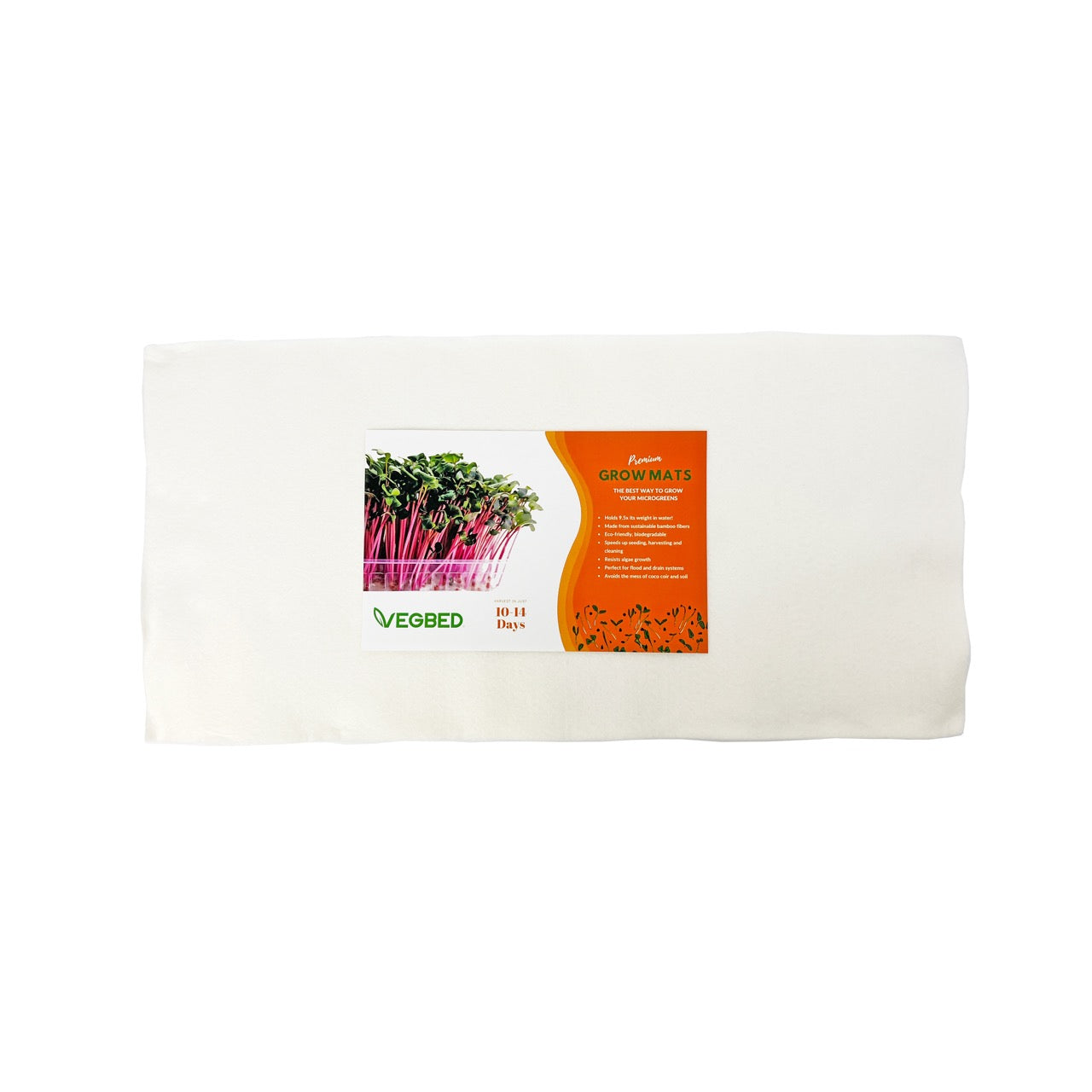



Every grower knows that a good harvest starts with a good foundation. We focus on light, temperature, and seed quality, but the grow mat quietly does the heavy lifting underneath it all. It’s where every root forms, where moisture meets air, and where consistency defines success.
Today, two plant-based materials dominate the sustainable grow mat space: hemp and bamboo. Both are natural, renewable, and biodegradable. Both promise cleaner growing and less waste. But once you look deeper into how they grow, how they perform, and how they fit into modern farm systems, you’ll see that they’re not quite the same story.
This guide breaks down what each material brings to the table and why the choice of substrate matters more than most growers think.
The Rise of Plant-Based Growing Media
Not long ago, microgreens were mostly grown on soil or synthetic pads made from plastics or cellulose. They worked fine, but left behind waste that didn’t always align with what small farms and eco-conscious brands stood for.
Now, things are shifting. Growers are turning to renewable plant fibers that align with clean growing and circular farming systems. Hemp and bamboo stand out for being natural, compostable, and scalable. But their sustainability starts long before they reach your tray; it begins in the field.
Sustainability Starts at the Source
Hemp and bamboo are both sustainable crops, but they behave differently in how they grow and renew themselves.
Hemp is an annual crop. It’s planted, grown, and harvested every year, typically taking 3 to 4 months to reach maturity. During that time, it grows about 7 to 10 cm per day and produces roughly 7 to 15 tonnes of biomass per hectare annually. While hemp grows quickly and can improve soil health between planting cycles, it still requires replanting, soil tilling, and ongoing maintenance.

Bamboo works differently. It’s a perennial, meaning it grows continuously without needing to be replanted. Certain species, like Moso bamboo, can grow up to 1 meter (or about 3.3 feet) per day under optimal conditions. Once established, it can be harvested annually from the same root system, yielding 25 to 30 tonnes of culms per hectare per year.
Bamboo thrives with minimal fertilizer and water and captures up to 35% more carbon dioxide than many trees of the same size.

From an environmental standpoint, that regenerative ability matters. Bamboo’s fast growth and high annual yield mean fewer resources are used, soil disruption is minimized, and the overall footprint is smaller. Compared side by side, bamboo not only regenerates faster but also produces more biomass per hectare, making it a more scalable and renewable choice for sustainable substrates.


Direct Comparison
|
Metric |
Bamboo |
Hemp |
|
Growth Rate |
Up to 1 meter/day |
7–10 cm/day |
|
Harvest Frequency |
Annually |
Annually |
|
Annual Yield |
25–30 tonnes/ha |
7–15 tonnes/ha |
How They Compare in Growing Performance
Here’s a quick look at how bamboo and hemp stack up in real-world growing situations:
|
Feature |
Bamboo Grow Mats |
Hemp Grow Mats |
|
Structure & Strength |
Holds shape throughout the entire cycle; resists tearing and fiber breakdown |
Can soften and break down faster during longer grow periods |
|
Odor |
Naturally clean with almost no scent |
Some batches have strong natural odors, depending on the supplier |
|
Water Absorption |
Absorbs evenly and holds moisture without oversaturation |
Good absorbency but may retain excess water, affecting airflow |
|
Cleanliness |
Tested to be 99+% pathogen-free, no additives or binders |
Quality varies depending on processing and binders used |
|
Longevity |
Maintains integrity for the full growth cycle |
Can degrade earlier under high humidity |
|
Compostability |
Fully biodegradable under normal composting |
Also biodegradable, but may take longer to break down |
|
Sourcing |
Perennial crop, no replanting needed |
Annual crop needs yearly replanting |
Both materials perform well when used correctly, but the small differences add up. Bamboo’s fiber density makes it more durable for consistent tray harvests, while hemp’s softer structure can be a good fit for short-cycle crops.
User Experience: What Growers Notice First
Ask any grower who’s worked with both, and they’ll tell you the same thing: how the mat feels and behaves day to day makes a big difference.
Bamboo mats stay neat and clean even after misting or bottom watering. They don’t leave behind fiber debris, which means less time spent cleaning trays between cycles. The lack of odor also makes indoor and greenhouse work more pleasant, especially in humid environments.
Hemp mats, on the other hand, have a soft texture that some growers like for delicate seeds. The tradeoff is that they can break down quickly and may leave residue behind after harvest, especially when reused or watered heavily.
For commercial setups, the consistency of bamboo mats helps maintain a predictable workflow. You can cut, harvest, and clean with less variation between trays.

Decomposition and the Return to Soil
At the end of each growing cycle, both hemp and bamboo mats can be composted, which is a win for sustainability. But the rate and cleanliness of that decomposition vary.
Because bamboo fibers are more uniform and dense, they break down cleanly over time, leaving no chemical residue. They can be composted with food waste or turned directly into soil conditioners.
Hemp decomposes faster due to its softer fibers, but depending on the binders or additives used by some manufacturers, the result isn’t always as clean. That’s why it’s worth checking what’s in your mat before adding it to the compost.
Beyond Materials: What Sustainability Really Means
True sustainability goes beyond having a biodegradable product. It’s about how that product is sourced, processed, and delivered.
At Vegbed, we look at sustainability from the ground up. The choice to use bamboo isn’t only about performance; it’s about resource efficiency and traceability. Our mats are made from responsibly harvested bamboo, processed without binders or synthetic glues, and tested for cleanliness to ensure that no pathogens reach your trays.
By starting with a renewable material that regenerates naturally, we help reduce environmental impact before the product even reaches the grower. That’s what we mean when we say sustainability starts at the source.
So Which One’s Better?
Both hemp and bamboo have their strengths. Hemp has a long history in natural fiber production and composts quickly. Bamboo, on the other hand, stands out for its strength, consistency, and renewability.
For growers who prioritize a clean, stable, and low-maintenance system, bamboo has a clear edge. It delivers a consistent growing experience and supports a truly renewable production cycle from start to finish.
Ultimately, the best substrate is the one that aligns with your growth goals and values. If clean growing, durability, and traceable sustainability are what matter most, bamboo is a smart step forward.
Why Bamboo Mats Make Sense for Commercial Farms
Large-scale growers are starting to notice what small growers already know: clean, consistent substrates make the job easier.
Farms like 80 Acres Farms have set the tone for modern microgreen production. Their automated vertical systems rely on uniform substrates that deliver even moisture and predictable results. A mat that drains consistently and holds its shape is a better fit for that kind of precision setup.
Bamboo mats align perfectly with that goal. Their even texture supports smooth seed coverage and steady root penetration, which helps automation perform more accurately. They don’t clump or shed fibers into nutrient lines, which keeps cleaning simpler and operations more efficient.
Commercial growers also care about cost and waste. Since bamboo mats don’t fall apart after one cycle and are easier to handle in bulk, they reduce overall material waste. Farms can maintain a cleaner environment, reduce downtime between harvests, and meet sustainability targets that more buyers and distributors now expect.
As the industry moves toward smarter and greener systems, bamboo’s combination of consistency, sustainability, and simplicity gives farms a reliable foundation to scale.

Final Thoughts
The conversation between hemp and bamboo isn’t about competition. It’s about progress. Both materials represent a move toward better growing practices and a more sustainable future for agriculture.
As growers, we get to decide which path we take. Choosing a substrate that aligns with how we want to grow and what we want to leave behind is part of that decision. Bamboo just happens to check every box: for performance, for consistency, and for the planet.
Are you exploring alternatives for a more sustainable microgreen farming?
If you’re curious or want to give our bamboo mats a try, just let us know — we’re happy to help you get started.