


At Vegbed, we have had the privilege of supplying Teens for Food Justice with bamboo grow mats for a few years now. Watching what their students do with them, growing fresh produce inside school buildings across New York, is genuinely something we are proud to be a small part of.
This post is our way of sharing their work with our community, because more people should know about it.
A Farm Inside a School
Most people picture a small raised bed when they hear "school garden." TFFJ is operating something on a completely different scale.
Teens for Food Justice (TFFJ) has been working since 2009 with one goal: to build a food-secure future through school-based, youth-led hydroponic farming. Their students grow and distribute 59,000 pounds of fresh produce every year, and every pound goes back to the communities that need it most. That number is not a projection. It is what they are doing right now, across 25 schools.

TFFJ school-based systems transform the student agricultural experience through high-capacity hydroponic farms led by expert Farmer-Educators, providing sustainable, fresh produce for the community—courtesy of TFFJ.
Each farm is a high-capacity hydroponic setup inside a school building, run by a full-time Farmer-Educator employed through the school and trained by TFFJ. Their farms grow a wide variety of produce, including leafy greens, herbs, and vegetables, as well as microgreens, depending on each school's system.
All of it is grown without soil and served in the cafeteria the same week it is harvested. Produce also reaches campus families and surrounding community members through local distribution partners.
Students are not growing plants for a grade. They are growing food for their classmates to eat at lunch. That is a different kind of accountability, and honestly, a different kind of pride.
The Science Behind the Greens
Microgreens are one part of what TFFJ grows, and the curriculum takes the science behind them seriously.
Students learn that microgreens are not just small plants. They are harvested at peak nutritional density, with higher concentrations of vitamins, minerals, and antioxidants than their fully grown counterparts.
They also learn why microgreens grow so fast. Most varieties are ready to harvest within one to two weeks of germination, which makes them ideal for a classroom setting where students need to see results and understand the process driving them.
From there, the learning gets hands-on. Students plant, monitor, and manage crops in a working hydroponic system. They study proper harvesting techniques to meet food safety standards required for cafeteria service.
They also learn how to build small-scale systems from repurposed food containers, so the skills they pick up at school are affordable enough to bring home.

Students gain hands-on experience managing high-capacity school farms, mastering nutrient density and food safety while learning to build affordable hydroponic systems for home use. Courtesy of TFFJ
The science and the real-world context are taught side by side. Students understand not just how food grows but why growing it this way matters for the people around them. One student put it simply: "It's crazy how nature can combine with technology." Hard to argue with that!
More Than Farming
What makes TFFJ different from a standard agriculture program is what happens after students learn to grow food.
They study the policies that led to food insecurity in their neighborhoods in the first place. They build research skills, learn to speak publicly, and engage directly with community leaders about why certain zip codes have far less access to fresh food than others.
TFFJ student interns have walked into New York City Hall to advocate for the Healthy Kids' Meal Bill, pushing for legislation requiring restaurants to offer menu options that meet expert nutritional standards.
These are teenagers doing this. On their own time. Because they chose to show up.
Their afterschool program connects students across cities, putting young people from different communities in conversation about shared food access challenges. Students develop their own ideas for solutions and build the skills to pursue them.
At their Denver partner school, students in grades 6 through 12 grow as much as 1,000 pounds of fresh produce every month, which goes into the school cafeteria and gets distributed to community members through a student-run farmer's market.
TFFJ is also collaborating with Denver Public Schools to develop a full urban agriculture career pathway for students in grades 9 through 12 at that campus.
That kind of progression, from student to grower to community distributor to career, is exactly what TFFJ is working to make normal.
Where Vegbed Fits In
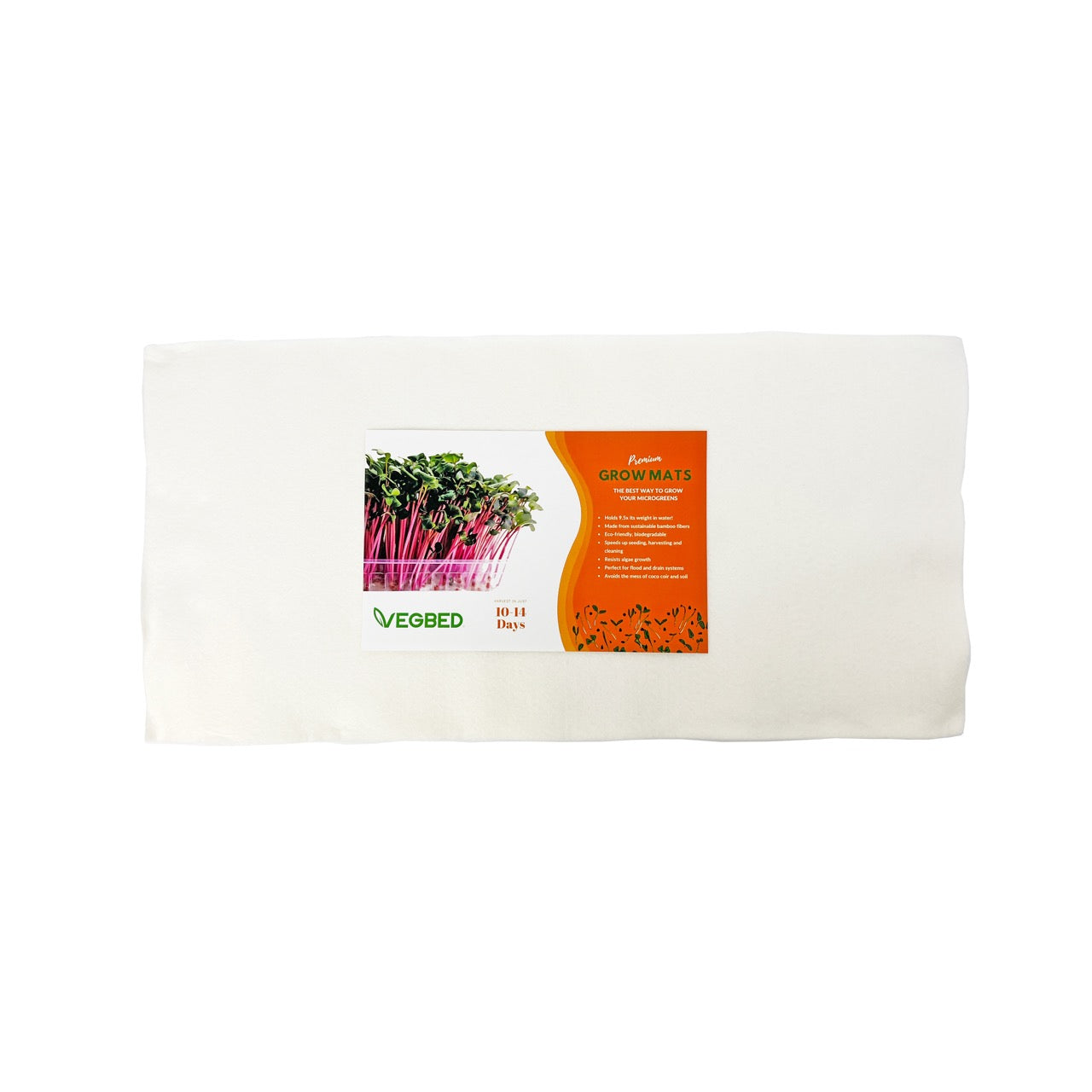
Vegbed has been supplying TFFJ with bamboo grow mats for the microgreens portion of their indoor farms for a few years now. It started as a straightforward supplier relationship. Over time, witnessing what TFFJ was building inside these schools, we wanted to do more than just ship product.
That is what led us to reach out and propose this collaboration. We wanted to help tell their story to a wider audience because we genuinely believe the work they are doing matters, and more people should know about it.
In a school setting where students handle food that goes directly into a cafeteria, the growing environment needs to be clean and simple. Vegbed bamboo grow mats are a pathogen-free, biodegradable medium that maintains consistent moisture levels for uniform growth.
Their ease of use simplifies the growing process, allowing students to focus on botanical observation and hands-on learning rather than managing the medium itself.
For a program teaching students that the choices behind food production have real consequences for communities and the planet, the tools used in the classroom should reflect those same values.

Microgreens growing on Vegbed grow mats in TFFJ’s flood and drain system. Courtesy of TFFJ.
The Bigger Picture
TFFJ's lifetime vision is not just to feed more people today. It is to end food insecurity in a generation by training the students who will eventually lead that change themselves. The farms are the starting point. The advocacy, the career pathways, the policy work, all of it is part of a long-term bet on young people.
When a student harvests a tray of microgreens or a head of lettuce that ends up on their classmate's lunch tray that same week, something real has happened. And somewhere in that process, they started to see themselves as someone who can actually change things.
That is what TFFJ is building, one school farm at a time.
This post came out of a simple belief: that the work TFFJ is doing deserves more visibility. We hope it gives their story a little more reach.
How You Can Help
If their work resonates with you, the most direct way to support it is through a donation. TFFJ runs as a nonprofit, and your donations go toward building farms, training Farmer-Educators, and running student programs. You can donate at teensforfoodjustice.org/donate.